Eggcorns, malapropisms and mondegreens: what's the difference?
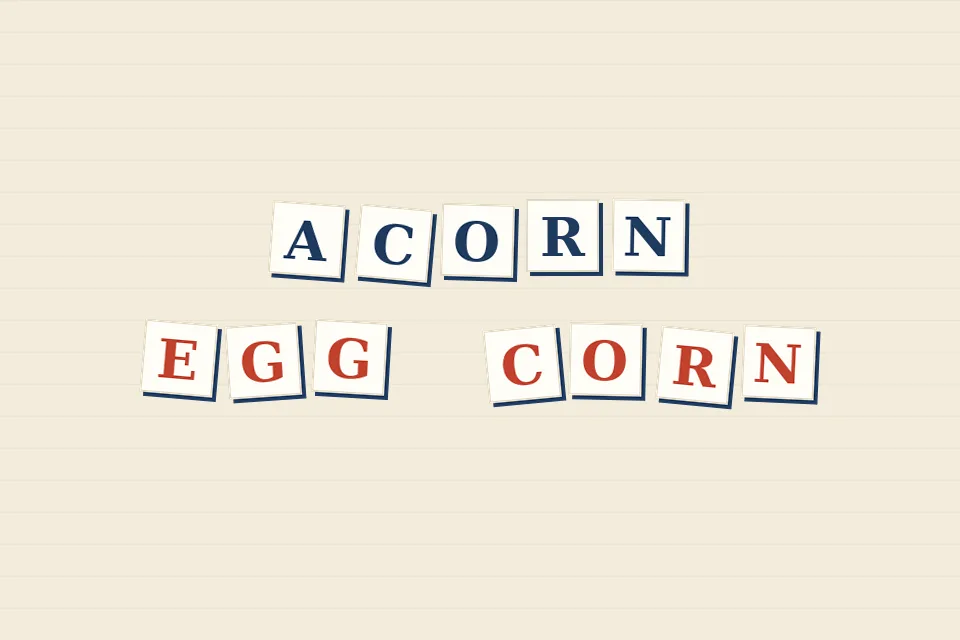
Someone writes that they waited with baited breath, gave a colleague free reign, or did something for all intensive purposes. Each is a real word put in place of another real word that sounds almost the same. Linguists have four names for mistakes of this family, and the differences between them say something about how we hear and remember language.
The short version: an eggcorn is a substitution that still makes sense to the person using it; a malapropism is one that does not; a mondegreen is a mishearing, usually of a song or poem; and a folk etymology is an eggcorn that a whole community has adopted, until it becomes the standard form. Here is each in turn, with the story behind its name.
Eggcorns: wrong, but logical
The word comes from a single example. On 23 September 2003 the linguist Mark Liberman posted on Language Log, a linguistics blog hosted at the University of Pennsylvania, about a woman who had written egg corns for acorns. In the post, Egg corns: folk etymology, malapropism, mondegreen, ???, he explained why the slip did not fit any existing label and asked readers for a better term. His colleague Geoffrey Pullum suggested simply calling such errors "egg corns", and the name stuck, later closed up into eggcorn.
What makes egg corn a good specimen is that it is not random. An acorn is roughly egg-shaped, and it is a seed, like a grain of corn. The person who wrote it had rebuilt an opaque word out of familiar parts that seemed to fit the meaning. That is the defining feature of an eggcorn: the replacement is plausible in context, at least to the person using it.
Some widely seen examples:
- baited breath for bated breath: bated is a shortened form of abated, "held back", a word few people meet anywhere else.
- free reign for free rein: the image is of loosening the reins on a horse, but a king's reign also suggests unchecked power, so the swap feels natural.
- for all intensive purposes for for all intents and purposes: run together in speech, the two phrases sound nearly identical.
- in one foul swoop for in one fell swoop: fell here is an old adjective meaning "fierce" or "cruel", and foul keeps something of that sense.
- old wives' tale becoming old wise tale, and deep-seated becoming deep-seeded, where the new image (wisdom, a seed planted deep) makes its own kind of sense.
Notice the pattern: the original usually contains a word that has dropped out of everyday use (bated, fell, rein for anyone who has never ridden). The eggcorn replaces it with a common word, which is exactly what you would expect if people remember phrases by meaning rather than by exact sound. Since 2003, Language Log readers and others have collected hundreds of examples; the largest list is the Eggcorn Database, started by Chris Waigl.
Malapropisms: wrong, and absurd
A malapropism also swaps one word for a similar-sounding one, but the result is nonsense in context. The name comes from Mrs Malaprop, a character in Richard Brinsley Sheridan's comedy The Rivals, first staged in 1775. Sheridan built her name from the French mal à propos, "inappropriate". In Act III, Scene III she complains of a "nice derangement of epitaphs" when she means a nice arrangement of epithets, and describes her niece as "headstrong as an allegory on the banks of Nile", meaning an alligator. The full text is free to read at Project Gutenberg.
The difference from an eggcorn is meaning. An allegory has nothing to do with the Nile, so the line is funny precisely because the substitution makes no sense. Liberman's 2003 post pointed out a second difference: malapropisms are usually words that merely resemble each other (allegory and alligator share a rhythm and some sounds), whereas eggcorns tend to be true homophones, or nearly so, in the speaker's accent. Shakespeare had got there first with Constable Dogberry in Much Ado About Nothing (around 1598), which is why malapropisms are also called Dogberryisms, though that term is rarer.
Spoonerisms, which swap sounds between words rather than whole words, belong to the same neighbourhood; they are covered with other sound games in anagrams, palindromes and pangrams.
Mondegreens: wrong, because misheard
A mondegreen is a mishearing, typically of song lyrics or verse, where the listener fills an unclear stretch of sound with words that seem to fit. The American writer Sylvia Wright coined the term in an essay published in Harper's Magazine in 1954. As a child she had heard her mother read the Scottish ballad "The Bonnie Earl o' Moray", and understood the lines
They hae slain the Earl o' Moray,
And laid him on the green
as a double murder: the Earl and a certain "Lady Mondegreen". Wright argued that mondegreens are often better than the original, and she was not entirely joking: the misheard version had given her a tragic heroine the poem never contained.
The word itself shows the process we described in our note on how a word gets into the dictionary: decades of citations before admission. Mondegreen was included in Random House Webster's College Dictionary in 2000, in the Oxford English Dictionary in 2002 and in Merriam-Webster's Collegiate Dictionary only in 2008, more than fifty years after Wright's essay.
A mondegreen does not have to make sense, and need not keep any of the original meaning. That separates it from an eggcorn, which is a reinterpretation, not just a mishearing. Liberman's other point holds too: a mondegreen comes from a performance (a song, a poem, a prayer recited by heart), while an eggcorn turns up in ordinary speech and writing.
Folk etymology: when everyone makes the same mistake
If an eggcorn spreads far enough, it stops being an error. Linguists call the result folk etymology: a word reshaped because speakers assumed it came from familiar parts. English is full of them. Bridegroom was Old English brydguma, "bride-man"; when guma fell out of use, the second half was reshaped as groom. Cockroach comes from the Spanish cucaracha and has nothing to do with cocks or roaches, and crayfish comes from Middle English crevis, related to French écrevisse, not from fish. Female was femelle in Old French, unrelated to male, but it was respelled to match.
The only real difference between these words and free reign is time and numbers. Liberman's distinction in 2003 was exactly that: a folk etymology belongs to a whole speech community, an eggcorn to an individual or a minority. Some eggcorns look well on the way: just desserts for just deserts (from deserve, not pudding) is now so common that many readers never notice it. As our guide to usage rules worth keeping, and myths to drop argues, dictionaries follow use, so a mistake shared widely enough eventually becomes the standard form.
Catching them in your own writing
Every word in an eggcorn is spelled correctly, so a spell checker will not flag baited breath or free reign. They are real-word errors, the same blind spot that affects homophones such as their and there. A few habits help:
- Distrust set phrases. Idioms are where eggcorns live, because we learn them by ear and rarely see them written. If a phrase contains a word you never use on its own (bated, fell, beck), check it.
- Ask what the picture is. Free rein is about horses; to toe the line is about putting your toes to a marked line, not towing anything. If you cannot say what the image is, look the phrase up.
- Look up the phrase, not the word. Most major dictionaries list common idioms under their key word, often with a usage note when a variant is common.
- Read aloud slowly. It will not catch an eggcorn that sounds identical, but it does catch malapropisms, which only resemble the intended word.
And if you find one in someone else's writing, a little charity is in order. An eggcorn is not a sign of carelessness so much as of someone trying to make sense of a phrase that stopped making sense a long time ago.
 Words & word games
Usage rules and myths
Split infinitives are fine; fewer and less still matter. A short guide to the rules worth keeping.
 Spelling & writing
Homophones spell checkers miss
Their, there, they're: real-word errors no dictionary lookup can catch.
 Words & word games
Anagrams, palindromes and pangrams
Listen and silent, racecar, the quick brown fox: the classic letter games and how to check them.