How a word gets into the dictionary, and into a spell checker
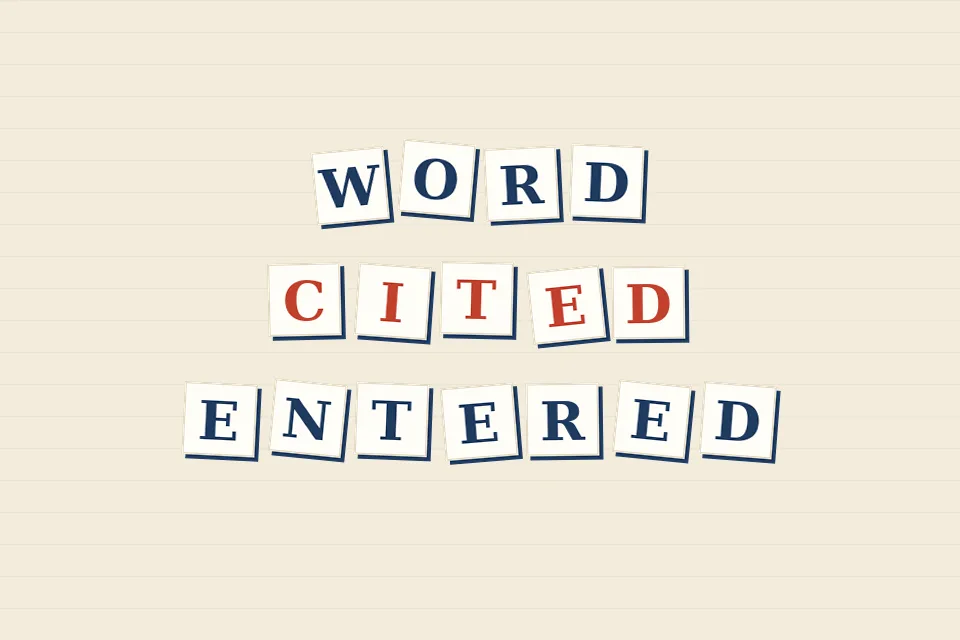
No committee votes a word into English. Dictionaries record words that people already use, and the question editors ask is not "is this a proper word?" but "is there enough evidence, from enough places, over enough time?"
That principle explains a lot: why slang turns up in respectable dictionaries, why a word can be "real" long before it is listed, and why your spell checker underlines words you see every day. This note walks through the process at two major English dictionaries and then follows a word one step further, into the lists that spell checkers use.
Dictionaries describe; they do not decree
Modern English dictionaries are descriptive. They aim to show how the language is used, not to rule on how it ought to be used. When a definition marks a word as informal, offensive or disputed, that label is also a description: it reports how the word is received. Usage advice exists, often in separate usage notes, but inclusion itself is a statement about evidence, not approval. This is why dictionaries list words people dislike, and why the complaint "that's not a real word" is usually a complaint about style rather than existence. Our notes on usage rules worth keeping, and myths to drop look at that boundary from the other side.
Step 1: reading and marking
At Merriam-Webster the process starts with reading. According to the dictionary's own explanation of how a word gets into a Merriam-Webster dictionary, editors spend part of most working days reading books, newspapers, magazines and online publications, looking for new words, new senses of old words and new spellings. Anything of interest is marked along with its surrounding context.
Each marked passage becomes a citation: the word, the sentence it appeared in, and the source. Merriam-Webster says its citation files were begun in the 1880s and now hold about 15.7 million examples, and that editors also search a large electronic corpus of published text. The citation, not anyone's opinion, is the unit of evidence.
Step 2: enough evidence, from enough places
A word earns an entry when its citations show that it is widely used. Merriam-Webster's criteria are worth reading closely: a word must appear in a substantial number of citations, from a wide range of publications, over a considerable period of time. A word used many times but only in one magazine, or only within one profession's jargon, may not qualify. The threshold also depends on the dictionary: a small abridged dictionary with limited space needs more evidence before it spends a line on a word than a large unabridged one does.
There are exceptions for words that arrive suddenly and obviously to stay. Merriam-Webster gives AIDS in the 1980s as an example of a term entered faster than usual because it became prevalent at once.
The Oxford English Dictionary works on the same principle with its own emphasis. As described in Smithsonian magazine's account of how the OED chooses new words, its editors look for several independent examples of a word in use and evidence that it has been in use for a reasonable span of time. Because the OED is a historical dictionary covering more than a thousand years of English, it has traditionally waited to see whether new words have staying power. Candidates that do not qualify yet are not thrown away; the evidence stays on file in case more turns up.
Step 3: writing the entry
Once a word is accepted, editors draft its entry: spelling and variants, pronunciation, part of speech, definition, etymology, and, in historical dictionaries, dated quotations showing the word's earliest known use. Research at this stage often surprises. Etymologists regularly find that a word thought to be new is decades older than anyone assumed, because an earlier printed example turns up in a digitised newspaper or book.
Spelling is part of the evidence too. Where a word is spelled in more than one way, dictionaries list the variants in order of frequency, which is how pairs such as color and colour get recorded side by side, each marked for the variety of English that prefers it; see American and British spelling for the main patterns.
A cautionary tale: the ghost word dord
The process is careful, but not infallible. The best-known failure is dord, which appeared in Merriam-Webster's Webster's New International Dictionary, Second Edition in 1934, defined as a term for density in physics and chemistry. It was never a word. It came from a slip of paper meant to record that D or d could be used as an abbreviation for density, which was misread as a single word on its way into the dictionary. An editor spotted that it had no etymology and no supporting citation in 1939, and the entry was removed in later printings. Merriam-Webster tells the story in "Dord": how a non-word made it into the dictionary. Lexicographers call such errors ghost words, and the lesson they draw is the one above: an entry without citations is a warning sign.
From dictionary to spell checker
A spell checker does not consult a dictionary in this full sense. It consults a word list: a plain file of accepted spellings, often with rules for adding endings. These lists are compiled from dictionaries and corpora, but they make different trade-offs.
- Size versus safety. A bigger list recognises more rare words, but it also accepts more typos that happen to be rare words. A list that includes the archaic wast will accept it when you meant was or want, and one that includes the rare cleek will not flag a slip for cheek. Many spell-checker lists therefore stop well short of a full dictionary.
- Update cycles. Lists are revised less often than online dictionaries, and software that bundles them may be updated less often still. A word added to a dictionary this year may take a long time to reach the checker in your editor.
- Names and trademarks. Many proper nouns, brand names and recent coinages are deliberately left out, or included only in larger editions.
The Letterbench spell checker uses SCOWL, the Spell Checking Oriented Word Lists that also underlie the English dictionaries of GNU Aspell and Hunspell. SCOWL is split into numbered size levels, and we use the levels up to 50, about 72,000 entries per variety of English, for exactly the reason in the first bullet. The spell checker documentation gives the details, and how spell checkers work explains how a list becomes underlines and suggestions.
When your word is underlined
An underline means "not in this list", which is not the same as "not a word". Before you change a flagged word, run through three checks:
- Is it in a current dictionary? Look it up in Merriam-Webster, the OED or another major dictionary. If it is listed, the word list is simply smaller or older.
- Is it the right variety? A British spelling checked against an American list (or the reverse) will be flagged even though it is correct. Switch the list, or keep consistent with one variety.
- Is it a name, a term of art or a coinage? Add it to your own words. In the Letterbench checker, "Add to my words" keeps it in your browser, so it stops being flagged on that device.
And if a word is not in any dictionary yet, you may still use it. Every entry started as a citation somewhere: a sentence by someone who needed the word before the dictionary did. Just make sure the reader can work out what it means, and that it is not a typo for a commonly misspelled word hiding in plain sight.
 Under the hood
Spell checker documentation
Where the 72,000-word list comes from and how suggestions are ranked.
 Under the hood
How spell checkers work
Word lists, affix rules, edit distance and how suggestions get ranked.
 Spelling & writing
American and British spelling
The handful of patterns behind color and colour, center and centre, -ize and -ise.