Silent letters in English: where the k in knight and the b in debt came from
Say knight, debt, island and ghost aloud and you will hear nothing of the k, the b, the s or the h. Each of those letters is silent for a different reason. Some were pronounced for centuries and quietly fell out of speech; others were slipped into the spelling by scholars and printers and were never pronounced by anyone. Knowing which is which turns a list of oddities into a handful of patterns, and patterns are much easier to spell from.
Two kinds of silence
English spelling settled down slowly between the late Middle Ages and the eighteenth century, and pronunciation kept moving the whole time. That produced two broad families of silent letters:
- Fossils: letters that record a sound English speakers really used to make, kept in writing after the sound was lost.
- Decorations: letters added to make a word look like its Latin or Greek ancestor, or simply by habit, with no sound behind them at any point in English.
A third, smaller group is not silent by accident at all: letters such as the final e of hope are markers that tell you how to read the rest of the word.
Fossils: sounds that fell out of speech
kn-, gn- and wr- at the start of a word
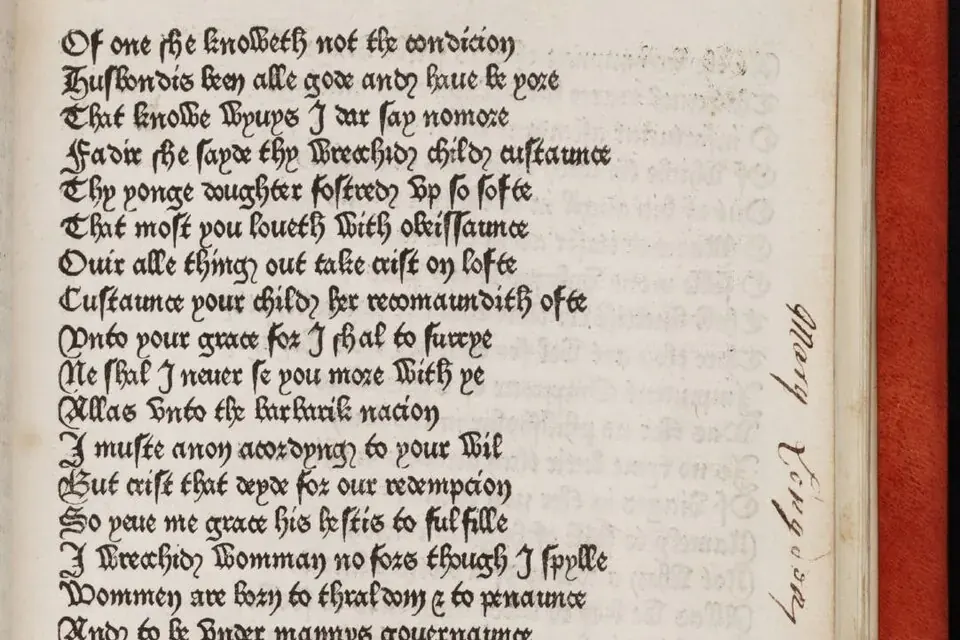
The k in knight, knee, know and knot was once pronounced, as it still is in the related German Knecht and Knie. Histories of English pronunciation date the loss of that k to the seventeenth century, at least in educated speech; gn- (gnat, gnaw) and wr- (write, wrong, wren) were simplified to plain n and r at about the same time. The spelling had already been fixed by printers, so it stayed. The photograph above shows Caxton's 1470s type spelling knoweth with its k, at a time when the sound was still there to be heard.
-mb at the end of a word
In later Middle English, a final mb was reduced to m, which is why lamb, plumb, climb, comb and tomb end in a b you never say. The b comes back to life when a suffix pushes it into the middle of a word in some relatives, as in bombard next to bomb.
gh in night and through
The gh of night, light, though and through stood for a throaty sound, like the ch of Scottish loch or German Nacht. Most varieties of English lost it, and in a few words it turned into an f sound instead (laugh, tough, enough), which is why gh is one of the least predictable spellings in the language.
Wednesday
The first d of Wednesday is a fossil of a different kind. The Old English name was Wōdnesdæg, the day of the god Woden. The middle of the word wore away in everyday speech, while the spelling kept the god's name intact.
Decorations: letters that were never spoken
The Latin b, p and c
English borrowed debt from French as dette, with no b. Writers later added the letter to show the word's Latin source, debitum; as Wiktionary's etymology puts it, the unpronounced b "is a Latinisation". The same thinking gave doubt its b (Latin dubitare), receipt its p (Latin recepta) and indict its c (Latin dictare). Nobody ever pronounced these letters in English. They were a nod to learning, aimed at readers who knew Latin.
island: a false family resemblance
Island is the classic mistake. The word is native English (Middle English iland) and has nothing to do with Latin. But the unrelated word isle, which does come from Latin insula through French, was respelled with an s in the sixteenth century, and the s was carried over to island because the two words looked like relatives. They are not; the s is pure decoration.
could: matching the neighbours
The l in should and would was once pronounced, because those verbs come from shall and will. Could comes from can and never had an l. It gained one in the early sixteenth century purely by analogy with its two neighbours, so that the three past forms would look alike.
ghost: a printer's habit
Old English gāst had no h. The gh- spelling appears in print in William Caxton's prologue to the Royal Book, printed in 1484, in a reference to the "Holy Ghoost". Caxton and his assistant Wynkyn de Worde both had ties to the Low Countries, and the h probably reflects a Flemish or Dutch spelling habit. The spelling stuck, and the h has been silent decoration ever since.
Greek ps- and pn-
Words such as psychology, pseudonym and pneumonia keep the spelling of their Greek sources. English does not allow a word to start with the sounds ps or pn, so speakers simply drop the p, though it is heard inside a word where the cluster is split across syllables, as in apnoea or synopsis.
Silent letters that do a job
Not every silent letter is a museum piece. Some carry information:
- Final e changes the vowel before it: hop and hope, bit and bite, cut and cute. It also stops a word ending in a bare v (have, give) and softens a c or g (dance, change).
- Family resemblance: the silent g of sign is heard in signature and signal; the silent c of muscle in muscular; the silent n of damn and autumn in damnation and autumnal. Spelling the root the same way keeps the family visible on the page.
- Telling homophones apart: the silent letters of knight and night, know and no, or write and right distinguish words that sound identical, which helps a reader even as it trips up a writer. Our note on homophones spell checkers miss covers the pairs that cause the most trouble.
Why nobody cleaned them up
Reformers have tried. Noah Webster's American dictionaries trimmed some letters that did no work, which is part of the story told in our guide to American and British spelling, but even he left knight and debt alone. Two things make wholesale reform hard. First, accents differ: a spelling that matches one region's pronunciation will not match another's. Second, the silent letters often link a word to its relatives, as with sign and signature, and removing them would break those links. The result is a spelling system that records history more faithfully than it records sound.
Spelling them without memorising a list
- Look for a relative where the letter is spoken. Bomb/bombard, sign/signature, muscle/muscular, damn/damnation. This trick works for many of the fossils.
- Learn the starting clusters as units. If a word starts with an n sound and feels old and short (knife, knock, knuckle), check whether it takes kn-. The same goes for wr- before an r sound (wrist, wrap, wreck).
- Group the decorations. Debt, doubt, subtle; receipt; island, isle; could, should, would. They are few, and each has a story that makes it memorable.
- Use a spell checker, then read its suggestions. A missing silent letter usually produces a non-word (nife, dout, recipt), which is exactly what a dictionary lookup catches. The Letterbench spell checker runs in your browser and will flag them.
Silent letters also explain some of the quirks of software that matches words by sound. Soundex works on letters, not pronunciation, so it codes the silent K of Knight as if it were spoken, a limitation explained in our walkthrough of Soundex in JavaScript. For the misspellings that have nothing to do with silent letters, from accommodate to separate, see commonly misspelled words.
Sources
- Wikipedia, "Phonological history of English consonant clusters" (reduction of initial kn-, gn-, wr- and final -mb).
- Wiktionary, English etymologies of "debt", "island", "could" and "ghost".
 Spelling & writing
Commonly misspelled words
Accommodate, separate, definitely: the traps they set and the tricks that fix them.
 Spelling & writing
American and British spelling
The handful of patterns behind color and colour, center and centre, -ize and -ise.
 Under the hood
Soundex in JavaScript
The census code that files Smith with Smyth: the rules, a tested implementation and its blind spots.